


‘Yima of Airyana Vaeja’
Prologue:
The last glacial period, often called the “last ice age,” peaked in Europe between 26,500 and 19,000 years ago, with the most severe cold conditions occurring from 26,000 to 20,000 years ago.
This period, known as the last glacial maximum, during the late Pleistocene, saw large ice sheets covering much of northern Europe, including what are now the British Isles, and ice caps in the Alps and Pyrenees.
It did not completely cover Siberia’s north and some of the Arctic Circle, where people had avoided the bitter cold. Gradually, the ice faded, and small family groups moved south, following the melting ice that watered the grass that fed the game animals. People split their travels to the east and west of the Urals as the ice of the snowpack eventually diminished and disappeared. There were no countries, cities, or kingdoms to name or refer to. It was still cool, but the climate changed yet again, water began to disappear, and then the land dried.
Trees and grasses died away, as did the plants and grazing animals. Gradually, even the fish disappeared when the streams and rivers dried up. Floods, dust storms, and fires devastated the remaining natural resources, triggering drought and famine. The various sorts of humans who had survived as hunter-gatherers in greater Asia trembled as famine and eventually, cannibalism became a gruesome and damning necessity.
In painfully slow increments of time, agriculture took hold out of desperation, people gathered into small groups, and then into cities. Trade and law were outcomes that led toward the dawn of civilization.
**************

Morning light cracked through the small Armenian hotel window as Gideon Yellow Thunder brought his wife, a paleontologist and paleoarchaeologist, Secora James, a mug of hot water and a bag of Constant Comment tea with its fragrances of orange and clove. He took a seat with his own cup. They had come here to relax and absorb their feelings while discovering Armenia with their travelling companion, Seamus McGill.
After they had barely taken a sip of the redolent beverage, their eager young Irish friend came into the room and pulled a brochure from his pocket. He eagerly unfolded it. “Hey guys, check this out. I found a map in the free pile at the library. It says we are situated in the Ararat Plain, flanked by Turkey, Iraq, Albania, and Georgia. Smack dab between Asia and Europe. Armenia is bordered on the south and east by Iran and Nachjavan, an Azerbaijan enclave. I’m interested in seeing a pilgrimage site near Mount Ararat, which used to be in Armenia before Turkey swiped it.”
Gideon asked, “Wasn’t this country formerly part of the Soviet Republic?”
Seamus sighed. “Yes, both Turkey and Russia have taken away large chunks of land. Armenia is now a fraction of its original size. Even though the nation has diminished, Armenia is proud to be one of the earliest Christian nations, and it’s defined by spectacular religious sites, including the Greco-Roman Temple of Garni, and four other 4th-century castles, churches, and monasteries. Its capital is Yerevan, where the Mahendran Library houses thousands of ancient Greek and Armenian manuscripts.”

(The above image is the Greco-Roman Temple of Garni today)
“You sound like a walking billboard.” Secora sipped and said, “Did you know that at one time Armenia spread over an area almost as big as mainland China? It was home to the clans and tribes, and civilizations of Airyana Vaeja. Traces of that name still live across Eurasia, like Iran, Eire, Ireland, Iraq, Erin, and Oran.” “How about Armenia?” Seamus enthused. “I mean, we’re looking at “Or”, “Ir”, “Er”, and “Ar” names as clues, right?” Secora rolled her eyes and agreed. “Armenia is special. Interestingly, before Christianity, the earliest Prophet we may have scriptural references for is Lord Yima – Bright Shining as the Sun – from Aryana Vaeja in Eurasia, perhaps in “Greater Armenia” before it was pillaged. Gideon scrunched his face and said,” Earliest Prophet? You’re saying then that this Yima came before Adam? Oh, that’s just wrong!” “He might have been earlier. We will never know all of the dates and times of each First remembered Prophet in a certain region.The “Firsts” of which I am aware, include Rama in Central Asia, Fo-Xi in China, Gayomart in Persian texts, Adam in the area of Mesopotamia, and Lord Yima or Yama, Known as the Son of the Sun.
“The term YIMA, or Yama, and later name versions like Jamshid, pronounced as Yom-shed and then Yima Ksheta, meaning Bright Shining as the Sun – Apollo-like, lasted over several thousands of years, anywhere in time between 22,000 to 10,000 years, or later. His latter manifestation, or more likely a descendant of His lineage, lived until the Bronze Age, – around 5,000 years ago. His name (or lineage) covered a period of several thousands of years – from hunter-gatherer stone age, through the beginning of agriculture and on into civilization as the “Lawgiver”, and beyond.
“He was surrounded by a radiant splendor which burned about Him by divine favor. Some call it ‘Farr’, a shimmering aura that can overwhelm onlookers when a divine being reveals the Word of God. Sometimes it is portrayed as a halo or aura, as with Christ.
“Jamshid (pronounced Yomshed), one of Yima’s latter names, remained humble, but this radiance allowed Him to command mortals, angels, and demons; banishing evil and rewarding good people.
“He was listed under ‘Firsts’ on an ancient tablet found in Persepolis; and because of this interesting answer given by God, known in that time as Ahura Mazda or Ormuzd – to the Persian Prophet Zoroaster’s query in the following passages in the Vendidad: .
“Zoroaster asked Ormuzd, ‘O Ahura Mazda, righteous Creator of the corporeal world, who was the first person to whom You taught these teachings? Who is the first man with whom you conversed?” Then spoke God (Ahura Mazda): “ O righteous Zarathushtra, I first did teach the Aryan religion to Him, (Yima the splendid who watched over His subjects) before you.” – The Vendidad
Gideon fidgeted. “What? That sounds so confusing, Secora.” “Just wait, He may have been the ‘First’ (of that previous age) – but according to tradition, He was not always the Revealer of God’s guidance.
At a subsequent time, Ahura Mazda continued:
“Yima spoke to me, and said he would like to spread the religion among mankind by teaching others. Then, I replied, ” Oh, Yima, you are not created for this task by me. You have not learned enough to increase the religion among mankind. – You are not the Messenger of the religion.
As I made my pleasure known to Yima, he proceeded south, towards the path of the high sun, increasing the land with his golden plough, conquering and cultivating the lands.”
“This suggests a future agricultural time, as humans moved into lands free of ice. The boundaries of the Aryan kingdom were extended in breadth, one-third greater than before.”
“Ahura Mazda visited him once more, warning him again of overpopulation. Yima, shining with light, faced southwards, once again towards lands freshly freed of ice.”
“Because a slow accumulation of agricultural abundance began to cause overcrowding, God encouraged Yima to proceed in the second great migration of the Aryans, towards the south and the west, even into Europe, thus extending the boundaries of the Aryan kingdom two-thirds greater than before.”
“A third crisis of abundance led to Yima increasing the land with his golden plough, towards the south and west… It became necessary for Yima the Splendid to enjoin righteous order on his subjects. It is said He controlled invisible time itself, making it much larger in size so as to praise and spread His righteous law.”
“This third great migration extended the ancient homeland, Airyana Vaeja (“j” sounds like “y’), the land of the Aryans, by four and a half times towards the south into Afghanistan and even the upper Indus valley..
“Rama or Ram – is likely Yima or Yama’s counterpart in early Hindu traditions, and as such, one Being might be the basis for both the Persian and Hindu Faiths; in the scriptural histories of both the Zend Avesta and the Vedas.
He may also be associated with pieces of the Atrahasis and Gilgamesh stories in Babylonia and Mesopotamia.”
Gideon sighed and rubbed his forehead. “How does that fit into history?”
“Well, these vast migrations displaced other local groups, or bands of ancient human forms, who were also struggling to make a living – especially in the light of massive climate changes from icepack, to plenty, to deadly drought. Some encounters with giants are remnants of legends and scripture.”
Seamus asked, “What else?”
“One of Yima’s most wonderful miracles occurred at Ahura Mazda’s (God’s) bidding. He ordered the people to build a vara underground settlement to avoid freezing and hunger. It would house hundreds of people, as well as the animals and plant crops. Such an underground city with thirteen levels still exists in Derinkuyu, Turkey. And people in parts of Asia and Siberia still move underground during winter cold spells.”
Gideon’s face was torqued with confusion. “So, what about Adam? Where does He fit in?”
Secora smiled. “Dear, the truth is that man has had guidance from his Creator since immemorial. Adam, whom we now recognize as the First Prophet of the last Age, is another example. He is also referred to as the First Mortal. However, it seems likely that Adam and Eve hunted and gathered relatively plentiful food before the Great Starvation, which actually may have taken their lives when the resources (Eden) disappeared.

“The couple may have suffered famine at the end of the time of plenty as represented by the Garden. However, they lived prior to the stage of domestication, where Cain and Abel were a farmer and a herdsman. Seth might have come at a later time, when earlier villages might have required the establishment of law and the beginnings of civilization. So they were possibly descendants rather than children of Adam.”
“Similar layers can be found for all of the Earliest Prophets we can recall. The first mortal, the first Prophet, the first agricultural king, the first lawgiver, etc. Obviously, specific dates and names don’t really matter.
“There is no way we can remember the dates of these Prophets’, or every layer of God’s Revelations throughout the millions of years of human development. We have relied on scriptural scraps, and tantalizing bits of wisdom, as well as fables, and parables from the most ancient times until the traces of Revelatory guidance could be recorded in writing.
“It is tempting to think that the begats of the Bible may be an attempt to remember the genealogy of the prophets, which would inhibit such overlap.”
Seamus snickered, then teased,“What, no amoeba, fish, or turtle guidance?”
She paused, looked at her cup, and then took a sip. “Oh yeah! You’re getting the idea.” Seamus and Gideon laughed. “Go ahead, laugh, but ask a Baha’i or a Hindu. We were guided throughout Creation. We even have shreds of wise advice on family and morality from a very early female educator – could be around Australopithecine times.”
“I’m so confused – I’ve never heard of any of them.” Gideon set his teacup down on a side table and shook his head as he mumbled, “This is what I get for marrying you, Secora.” He reached over and kissed her. Then Seamus stood up and headed for the door as he said, “Let’s grab some breakfast.
We have a big day of exploring ahead of us!”
*********
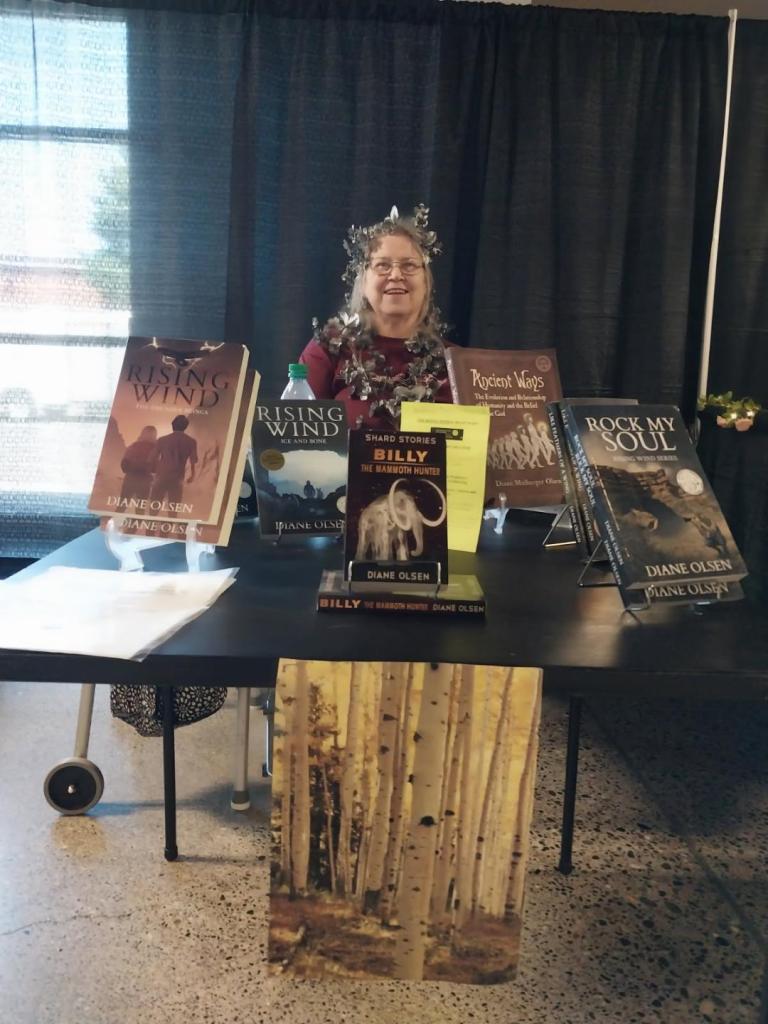
Visit my Amazon Author Page to learn more about
The ‘Rising Wind series’ of novels, Ancient Ways,
and all other books on Amazon!
https://www.amazon.com/stores/author/B01LWDB4K7/allbooks <<




 Diane Olsen Author, Books, & Stories