

Celebrating National Kayak Day In honor of Native American Heritage Month.
Today we celebrate ‘National Kayak Day’ and the history of the kayak, a narrow watercraft originally created by Arctic tribes 5,000 years ago, and the role it played in their everyday lives.
(Let’s learn more courtesy of Google Doodle & (Image courtesy of NOAA Fisheries)

These small and narrow watercraft were created thousands of years ago for hunting, fishing, and transportation. Kayaking has since evolved into a widely popular recreational activity and competitive sport.
Native American communities in arctic regions are to thank for these paddle-powered boats. Kayaks were originally invented by Northern tribes including Inuit, Aleut, Inupiat, and Yup’ik, and made with animal skins, bones, and driftwood to help traverse cold waters. These boats offered hunters the stealth and mobility to successfully catch fish, seals, whales, and more in even the most treacherous waters.
Image Below Credit: Smithsonian Institution
The best weapons to use in a kayak were darts and harpoons. Bows were easily damaged when wet and were best left for hunting on land. Many harpoons included a throwing stick that increased the range and force. At the end of the line was often an inflated bladder that kept the line afloat and tired the targeted animal.

It’s only fitting that the word kayak means “hunter’s boat” in Inuit.
Qajaq, the etymological form of the word, stems from one of the 14 dialects of the Inuit-Yupik-Unangan family of languages. Each Qajaq was customized and hand-built by the hunter to account for their own size and weight and thought of as an extension of the self rather than just a tool.
Kayaking has since evolved into a sport and recreational hobby that welcomes all who enjoy time out on the water. From leisurely rides across still lakes to competitions over treacherous white waters, kayaking is now worldwide. We have the Northern tribes to thank for this sporting advancement.
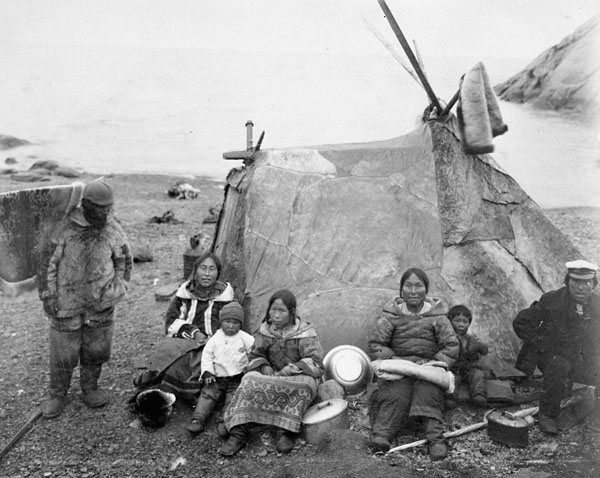
(Below is an Inuit family in front of a ‘Tupiq; (a tent made of animal skins and used in the warmer months) at Pond Inlet in 1906 before Canada drove them out.)
I hope you have enjoyed reading about artic native history of the kayak and the native people. In my next post soon, I’ll be sharing a new captivating short story.
Until next time!
Happy Autumn Reading!

 Diane Olsen Author, Books, & Stories