A Special Shard Story From ‘Rays of One Light’ – not yet published of the ‘Rising Wind Series’ from Book 7…

 
The Weaver and the Princess
From Rays of One Light
Three-Part Story…


Secora James and Destiny Hawkins arrived at the ranch just as the sun rose on the last day in the Baja desert. Soon, they would have to return to their jobs at the University in Missoula and offer summer classes. Once they parked, they found horses saddled and waiting for them inside the vertical pole corral.

“Only two horses. Guess we’ll be going in alone again,” observed Secora. Pointing to the fence, Destiny asked, “Don’t those poles look like those spindly boojum trees we ran into yesterday?” Secora nodded, “Interesting observation.” After tightening the cinches on the bay and placing the bridle over the mare’s head, she tied the halter and rope with leather strings set near the saddle horn, and her gear bag was bunched at the back of the cantle.

A young woman wearing a protective pink and gray rebozo shawl over her head and shoulders came to greet them at the corral, humbly notifying them that her husband, Alfonso, could not take them out because he was still sick. Apologizing in broken English, she suggested a trail that would lead them to the nearest painted rocks. She added that several of the large murals were more difficult to find, but these smaller ones could be found just off the trail.

She smiled, then cautioned in Spanish, “Watch out for the spirits.”
“Spirits, Pepita?” Secora asked.
“Yes, the blessed spirits who move silently… like ghosts.”
“We will try to be respectful, thank you.” Secora and Destiny looked at each other, wondering how to interpret her words. Then, bidding Pepita and Alfonso, who waved weakly from the door a good day, the women mounted up and took the suggested trail

Destiny asked, “So, is “anima” ghost… or spirit?

Secora shrugged. After a moment, she sighed. “Perhaps she knows about some tragedy in that area. Guess it doesn’t matter.”

“Right, I suppose, spirits are everywhere.”
Hooves clattered over a thin, stony trail; half hidden on the side hill. Secora drew a breath. “This is our last chance to see the place where little Diegoaelurus, the precursor to mammalian predators once roamed.”

Destiny added, “Hopefully, we’ll be lucky enough to take in a boldly painted black and red mural.” They headed for a low ridge that dropped down into a basin toward the west, where they hoped to observe some of the impressive art left by the Archaic people who lived there more than 10,000 years ago.

Destiny reflected, “I hope we don’t get lost.”

Secora said, “We won’t. I usually turn around every few hundred feet to see what the trail will look like on our way back.”

“Yeah, and I guess we could take pictures of the main features in case we get stuck.”

“Good idea.” Secora nodded and lifted her camera. 

The changes and chances of weather and rainfall in the Baja Peninsula required special adaptations from the plants, animals, and people who lived there. Secora noticed a variety of vegetation unexpected in a desert with such wildly variable rainfall patterns and extensive droughts.

Life forms took advantage of hidden pools and ephemeral rain. Yet they must somehow survive the rare monsoonal deluges produced by storms that struck the peninsula and roared their way inland. Gashes caused by massive flash floods ripped through the terrain, leaving driftwood and huge gravel ridges along their paths.

The horses sauntered down a dried creek bed, while the women scanned the cliff sides.
Would this be the day they’d catch a glimpse of something wonderful, striking petroglyphs, or perhaps one of the well-preserved red and black murals that had caused the region to be declared a World Heritage site comparable to European Cave Art? In the distance, they saw a few wispy pines, stunted cedars, and century plants erupting from rock, gravel, or sand along the hillsides.

As they dropped into a narrow canyon, they cleared a tight corner and ran smack into a patch of jumping cholla cactus, strategically hanging over the trail. Destiny tried to steer clear, but one spike attached itself to the chestnut gelding’s mane and neck, causing him to toss his head and sidestep toward another branch. She dismounted to control the animal. “Ouch! Dang, we got too close.”

On foot, they carefully wended through a hundred feet of the dangerous spines before escaping the last of the beautiful but wicked cacti. Destiny tried to steady the gelding, while Secora grabbed a pair of needle-nosed pliers from her backpack and began plucking the painful spines from the horse’s neck. When he jerked his head, three spines ran into Destiny’s fingers. “Blast it!”

“Yeah, but it’s hard to deny how good it feels to let them do the walking.” They topped a second ridge and saw a set of beautiful palms and several species of euphorbia sprouting from the smaller side of the canyons along the arroyo.

Destiny was moved to comment, “It’s fascinating. When you look out to the horizon, lush greenery is what you see. It hardly looks like we’re in the midst of a hot, dry desert.” She stopped to take some photographs. “Oh look, I think that modest looking succulent near your horse’s leg might even be a lady slipper.”

“Couldn’t prove it by me. It’s getting on toward noon, but it’s too hot to think about eating, let alone categorizing succulents.” Destiny arched her back in a stretch. “I thought it was supposed to be cooler today, but… oof, it feels like an inferno.”

Secora pointed and spoke in a loud whisper, “There! I saw movement. Across the basin, over to our left. I think there were two or possibly three people.” “Out here?” Destiny was silent for a while as her eyes searched up and down the terrain. “People or ghosts? I can’t see anything.”

She used the telephoto to snap a picture in that direction, but her eyes saw nothing. “Where are they? Sure you didn’t see deer.”  “No, I’m pretty sure. I saw two, maybe three people walking at the base of that cliff across the basin. They were at that ruin across the way, beneath the stack of old log poles that might be remnants from a caved-in roof, but I don’t see them anymore.”

“If they were there, they probably sat down for a rest.”
“That’s certainly possible, Destiny. But now I’m seriously curious about why those old poles are clumped together.”
“Perhaps from a flash flood?”
“Could be, or they could be repurposed from an old construction site.”
Let’s go check.”

********* *********

These exciting mystery novels unfold in various multicultural settings around the globe across the first seven books. The series has received 5-Star Editorial Book Reviews from Book Influencers Reader’s Favorite, and it has won several awards, including the Book Excellence Award and the Christian Illumination Award, among others.

If you’re a reader or a movie enthusiast who loves the “Indiana Jones” saga and enjoys mystery, action, and adventure, you’ll love reading all seven books in the thrilling and gripping “Rising Wind” novel series.

Books are available from Amazon in paperback and Kindle.
Read it free with Kindle Unlimited, & Soon they will be
Available as audiobooks, too!
https://www.amazon.com/Rising-Wind-3-book-series/dp/B093PRX88L/


Part Two –‘The Unique Settled History of Sweetwater Canyon’ Areas of Colorado Springs, CO. . .

For me, the Green Settlement was the first magical surprise on the trail north of what is now called Greenwood Park. As I first rode through there in awe, I found inch-wide, tiny deer tracks that looked like they belonged to miniature deer, or fawns – not our big mules, sunk deep into the dead pine needles. There were also the ruins of two old cabins, more like rotting logs in the shape of foundations, close to a giant boulder. Dad later told me it was known as the “Green Settlement”.

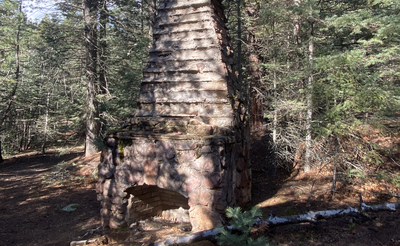
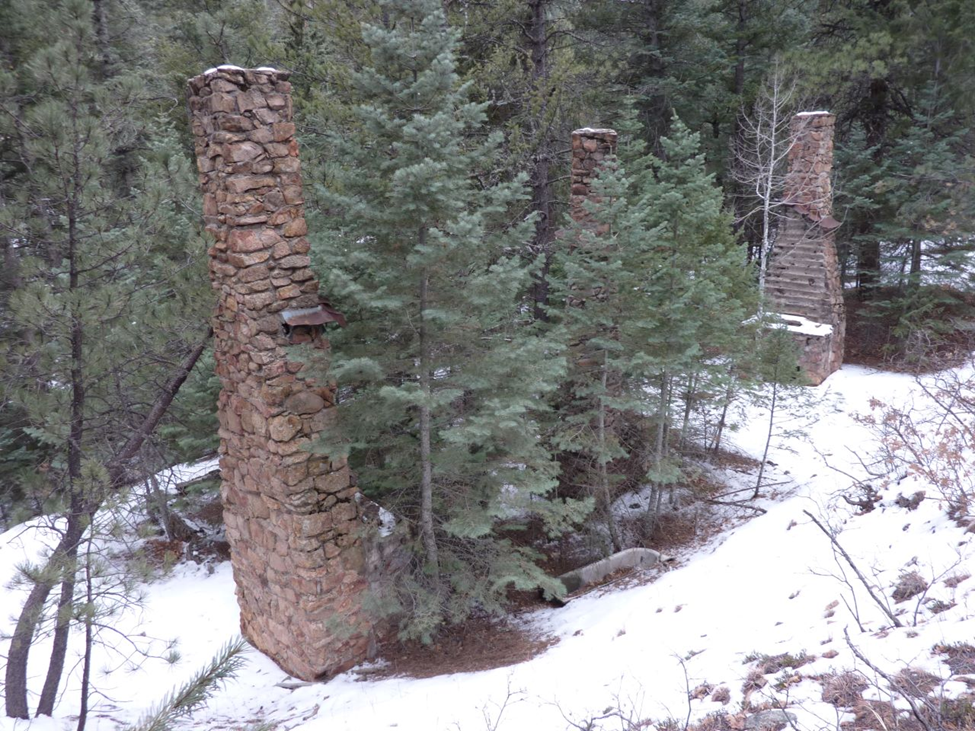
Of course, an unexplored “settlement” was like honey for us kids. After climbing straight uphill from the valley behind the “three chimneys ruin” (picture below), we dropped down a very steep trail to get to the settlement which actually turned out to be the remains of only two cabins, and perhaps a root cellar, or prospect pit. We kids managed to get there alone, or in pairs; on horse or on foot. For us, finding that hidden jewel was breathtaking, I mean, it really was. The area seemed closed off from the outside, almost stuffy like the wind hardly ever blew there.

Very few of the cabins remained, and if you were not careful, you could easily miss one or both of the foundations. Sometimes, I only saw one. There was a sign that read “wagon road,” two mounds, and the huge boulder on the right if you were coming from Greenwood Park.


‘The Green Settlement is a historic homestead site in North Cheyenne Cañon Park, Colorado Springs, Colorado. The remains of the settlement are located in a forest below Daniels Pass. Green’s Settlement Hike – a 6-mile hike along mostly easy trails with some climbing (1,200’ vertical). It is an out and back route from Pulloff 21 – Daniel’s Pass Trail and connecting Daniel’s Pass Trail, Sweetwater Trail, and Greenwood Path. Plan on a 3-hour hike.


I remember my sister Sandy found a crumbling rusted-out lantern frame near one of the foundations. On another occasion, we with our cousins, managed to climb the giant rock. It took some effort, but we ate sack lunches up there until we felt a bit eerie and decided to leave. Maybe Clara had joined us, lol. We’d follow the faint trail back down the gully to the mysterious three chimneys, and back to Basing’s, the home we knew in the valley at the time. The land had changed hands several times, and now it was the Basing’s property.

 By now, you’ve probably figured out that the mysterious “Greenwood Settlement” was the property of the courageous Clarra Cassatt. Why Clara’s place was known as the “Green Settlement” is a mystery, as is the name Green in Greenwood Park. There’s another mystery. Who built those structures that held the three lonely stone chimneys, and who burned them down? Maybe you can find the answers.

Photo (below) by Eric Swab


Frederic R. Smith, a Colorado Springs banker, replaced Bertha’s family and friends, as the energetic owner who had big dreams in the Sweetwater Valley.

A 1928 Gazette article mentions that the road that branches off the Old Stage Road near the “Voss Chimney” was Frederick Smith’s private auto access. Eric Swab told me the work was done by Henry B. Martin (Bertha’s son-in-law) along with a Mr. Mosier the owner of the property “south of Greenwood Park” Whatever that meant.

Frederick likely built a summer house and 8 ponds for trout at the canyon. However, nothing definitive of his home remains except a charming photo of a nice house overlooking a pond, in a clipping that Eric found, and a couple of small pond basins. I vaguely remember seeing two or three cement-ringed basins way down the meadow below Basing’s home in the 50s and 60s. Several other broken earthwork dams once held fish, of course, there is nothing left to see in 2024 when my sisters and I last saw the meadow.


Remnants of those ponds must have been the inspiration for my dad to build his trout dams in Twilight Canyon.

Our house overlooked the middle of the dam, much like Frederick’s home in the photo.

I feel pretty certain Smith built the reservoir and pumphouse up by the bridge over Sweetwater Creek, which was destroyed by Subsequent owners, toward the upper-end of the valley. Frederick may have been the reason for the many raspberry bushes in that area, as well as the currants along the reservoir’s rim. This makes sense since the bushes did not seem to grow anywhere else in the valley. It is uncertain whether he built the music house and the garage, and I can’t recall who else might have done so.

Further down the valley from those properties, to the southeast, where the canyon walls become very steep, there is a junction where Sweetwater Creek flows into South Cheyenne Creek. It was there that in 1926 Frederick proposed to construct a huge 75-foot-tall dam. It never came to be, I guess.

But I remember chunks of cement and lots of iron rust littered the stream in that area, so who knows? If he had managed to complete it, we Mulbergers probably would not have lived where we did, and the folks at Seven Falls would have had a serious fit.

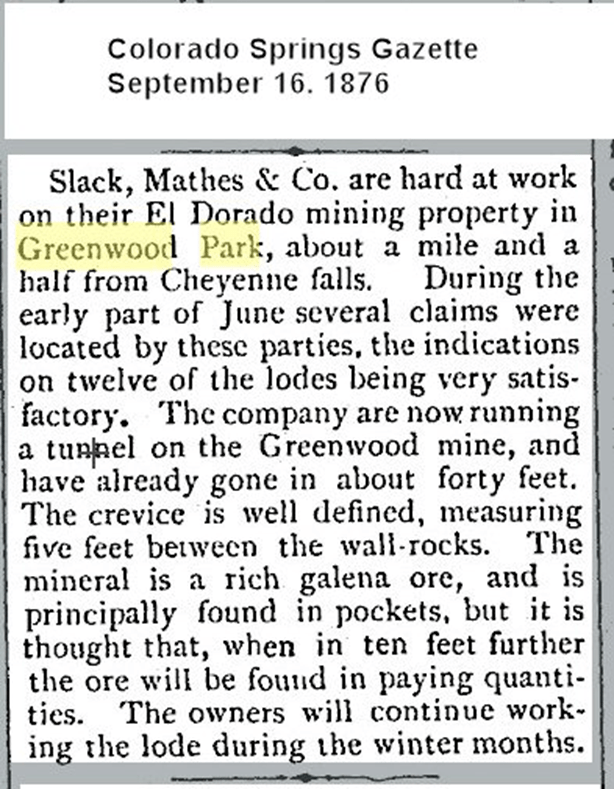
A few years back, Eric sent me this article that would have fit into that general area.
Article supplied by Eric Swab


Fred, the banker later sold the property to Frank Cheeks, who passed it along to his daughter Dorothy Smith. Dorothy was the curator of the Pioneer Museum in Colorado Springs. She then bought it back in 1944. Eric has a photo of her sitting atop a horse. She was the second Rodeo Queen at Pike’s Peak or Bust Rodeo.

The Pikes Peak or Bust Rodeo has been a Colorado Springs tradition since 1937, showcasing the top rodeo talent and action, while providing wholesome entertainment for the Pikes Peak community to enjoy.”


Dorothy owned Georgianna Russell’s place between 1944 and 1948. She sold the land in 1948 to my dad, Hank C. Mulberger, and his friend, Myrtle Basing. Basing apparently never platted the land in Sweetwater Canyon, and his name, oddly, doesn’t appear in the ownership records. Another one of those mysteries.

Myrtle (Mert) Basing was a friend of Dad’s from back in Wisconsin. He was a Green Bay Packer from the thirties, and or, forties – when there was no padding on the uniforms, and the helmets were made of leather with long ear flaps, as the only real protection. He was the co-pilot who flew over the property with Dad when they decided to buy the 160 acres and split it into 80 acres each.

Basing’s gorgeous resort-like home was faced with logs. I thought it was a log home, but the back and side walls were formed with cement. The entrance opened into a humongous living room with a lovely fireplace in the middle of the east-facing wall, and at that end, there were two large picture windows. There were two sets of other picture windows in the living room, one on each side of the front door.

At the west end, there was a kitchen smallish and quaint, and a stove that I thought was wood or coal, which was always busy baking bread, or some such. That stove was later changed for a gas range, probably from Montgomery Ward’s. Most of our furnishings seem to have come from the “Monkey Wards” catalog at the time. There was a side-door exit, beyond a pantry and perhaps a small bathroom. The exit was out near the retaining wall between the house and the garage. Later, a propane tank was installed by that wall.

There were three levels. A half-level up featured the bedrooms and a bathroom, arranged along an enticing, pine-paneled hallway. The half-level had an unobstructed view of the living room below it. The hall ended in a door that opened – but went nowhere – except down – I guess the steps never got made. At the other end of the lovely pine board hall, toward the kitchen, was a linen closet, and to its left were a few stairs that led up to an expansive, open loft with a piano, then the dining area and long living room lay below the loft.

Laurette Basing was very kind and tried to teach Sandy and me needlework. I remember she had one of the old tomato style needle sharpeners. She also prepared and tended the most beautiful perennial garden I have ever seen. It was loaded with beautiful blooms.


She had several colors of columbines, hollyhocks, and snapdragons; she showed us how to open and close their tiny mouths. There were also glorious daylilies and tiger lilies, as well as morning glories, foxgloves, delphinium, dahlias, gladiolus, and Johnny jump-up pansies. Most memorable though, were the Irises. Her Irises were unbelievably big and beautiful and came in mauve and maroon, and many shades we’d never seen before. Sandy and I got our life-long love of irises in that garden.

In the 1960s my favorite memories were picking red raspberries that must have gone wild all along the road from the bridge. where buildings once stood. My sisters and brothers -Val, Fella, Peter, Sandy and I, would carry pitchers of the treasured fruit to Eleanor, who became part of our family after my mom, Peg’s death. Eleanor’s jam was marvelous. Only once, do I remember competing for the berries with the bears, at the Basing’s place. We left! In our 2024 visit, there was not a single raspberry or current bush to be found! Too many flash floods.

When we last saw Laurette’s Garden beneath the patio wall, on a nostalgia trip at a family reunion in the early 1990’s, the retaining walls were gone, and it was a ruin. All of us kids were together when we looked at what was left of the burnt building. There were still some brave, volunteer irises in the old bed, under where the patio once was. Through the decades, Sandy and I dug some to take with us wherever we went, as a reminder of that lovely place and time. In 2024 we noticed brave sentinel irises popping up around the meadow because the flower bed from nearly 70 years ago been destroyed.

The expansive cinder block patio bricks above the garden had been pink and gray. I remember looking out the screen door from the Basing’s living room, watching a cat come softly padding-right across the patio toward me. It was about my height and had beautiful white markings around its mouth and eyes – which were staring right at me – about two feet away. At first, I was awed by its beauty, then it got creepy and I was frozen.

I tried to say something to Mom about the kitty, and eventually, she and Laurette stepped over and closed the door on the cougar. Looking back, I can see that it was curious rather than threatening – but still, a flimsy screen in a door is too fragile for protection. We went all over those mountains and never got eaten, although Sandy had another close encounter at our house, which wasn’t far from the Basing’s, and it could easily have been the same animal.

The Basing’s had two domestic cats; one lived until it was 16, the other maybe 12 or 14. That was the longest I’d ever heard of at that time. Most outdoor cats, even today, live 6 or 7 years. They also had a dog, a huge German Shepherd. Our parents had that dog’s brother, whom they loved and they called him “Big Mike.”

Photo of Peg and Big Mike. Hank and Peg, once called it the “honeymoon shack”.


For some weird, unknown reason the Basing’s dog came over into our canyon one day, and attacked Mom from the back when she was hanging out laundry on the clothesline in the yard outside the kitchen window. I think it bit her back and arms, then she ran into the house to get a .22 pistol and shot the dog in the head trying to kill it, but the bullet lodged in its skull, and the animal ran home. The dog didn’t die, but the Basing’s were horrified by the fact that Mom had shot their beloved pet.

For their part, Mom and Dad could not believe the Basing’s were unsympathetic to Mom’s circumstance. This was a catastrophic event that happened around 1956-7. Mert and Laurette refused to get rid of the dog, and unfortunately, that ended their long-time friendship. Sadly, Mr. Basing died shortly after that from a heart attack.
We children felt awful but didn’t know what to do. . .

************

PART THREE Will Be Posted
Very Soon!

Author Diane Olsen